Sunday, March 16, 2014

Four China Reforms to Watch

Four China Reforms to Watch

xi-jinping
   Print
Investors are still chewing over the implications of the sweeping reform package Chinese leaders laid out at the end of a major Communist Party gathering earlier this month, but one thing is already abundantly clear. The Chinese government wants the world to know it is serious about opening up its economy and liberalizing its financial system. To that end, it unveiled a variety of planned initiatives, from land reforms to a relaxation of the infamous one-child policy, the majority of which are intended to help the country sustain long-term economic growth. And the world was impressed. Dong Tao, Credit Suisse’s Chief Economist for Non-Japan Asia, called the initiatives “the most comprehensive reform package we’ve ever seen in the history of the People’s Republic.”

The news comes at the right time. Credit Suisse Head of China Research Vincent Chan said that before the reforms were announced, the Chinese economy lacked clear drivers to even ensure steady long-term growth, let alone the blistering 7.5 percent-plus annual GDP increases it has enjoyed for the last decade. The $585 billion stimulus package approved in 2008 to stave off the effects of the global financial crisis buoyed the economy for two years after it was introduced, but the effects have since worn off. Economists have also become concerned about China’s soaring credit-to-GDP ratio, which has risen from 120 percent to more than 180 percent in the last four years, largely as a result of local government borrowing.

The most immediate beneficiaries of the reforms announced after the Third Plenum meeting will likely be China’s banks, which have an aggregate market capitalization of $850 billion. Though Chinese banks have enjoyed 28 percent compound annual earnings growth since 2009, their forward price-to-book values have dropped from 1.6x in 2009 to 0.9x today, according to Credit Suisse’s China banks analyst Victor Wang, primarily due to growing investor concern about their deteriorating risk profiles. Wang believes the banking sector should be valued 28 percent higher than it is at present, and thinks the announced reforms will be a catalyst for at least some measure of multiple expansion. “There will be a lot of positive spillover from the other reforms into the financial sector,” he says. “Some of the banks are trading at a meaningful discount-to-book value. That will be reduced soon.”

Credit Suisse also expects the insurance, property, transportation, energy, materials and consumer discretionary sectors to outperform as a result of the announced reforms. Though in many cases the government has not laid out a precise road map or timetable for implementing changes, “if even half (of the measures) go through, China will look very different five years from now than it does today,” Tao said on a recent call with investors. The Financialist has distilled the insights of Credit Suisse’s China team to provide an overview of four of the most important reforms.

Fiscal Reform

China’s banks are likely to be the biggest winners from an initiative that will see the central government take over responsibility for major infrastructure projects and social welfare initiatives from local governments. As it stands, local governments are responsible for a disproportionate amount of spending (85 percent), while getting a relatively small piece of tax revenue (52 percent). To this point, provinces and municipalities have borrowed money through specially created “local government financing vehicles” to bridge that gap. In the process, Credit Suisse analysts point out, they have racked up as much as 17 trillion yuan ($2.8 trillion) in debt, a not-insubstantial portion of which has been backed by infrastructure projects that might not have made it through a cost-benefit analysis in the private sector. By taking some of that responsibility for spending away from local governments, the country’s leaders are clearly hoping to slow down the accumulation of debts that have made investors nervous about Chinese banks.

Documents released after the meeting also call for creating an “early warning system” to flag when local debt levels are approaching dangerous levels. In most places, that “early warning system” is known as publicly available financial accounting, but to this point, that’s been a rarity among local Chinese borrowers. But that seems likely to change as well: Municipalities also received a formal go-ahead to raise money by issuing bonds, something that to this point has only existed on a small scale in pilot programs.

Of course, fewer large, local-government-financed construction projects will also reduce annual GDP growth rates from just below 8 percent to the 5-6 percent range over the next five years, Tao says. But for investors nervous about the solvency of Chinese financial institutions, higher-quality and more transparent growth will surely prove preferable to what was threatening to become unsustainably rapid economic expansion.

Reducing the Government’s Role in the Market

One primary message of the plenum was an intention to shift the balance of roles the free market and the government will play in organizing the Chinese economy going forward. The government, for example, is considering allowing markets to set prices on goods such as water, natural gas, power, transportation, telecommunications and oil. Wang points out that the government has also signaled a desire to give banks more latitude in the interest rates they are allowed to pay on deposits, which would force Chinese banks to compete with one another and potentially give households a chance to earn more interest on their savings as a result of that competition.

The reform package also stressed the importance of moving to a market-based exchange rate and full convertibility of the renminbi, China’s currency. That follows already-announced plans to test financial deregulation and relax restrictions on cross-border currency flows in free trade zones in Shanghai and Qianhai, a district of the Hong Kong border city of Shenzen.

Land Reform

In one of the most clearly articulated reforms, the government announced plans to give Chinese farmers more leeway to sell, rent or mortgage their land. For decades, farmers have “collectively” owned rural land, with the result that they weren’t allowed to sell it on the free market. Instead, local governments have acquired the land then sold it to developers for commercial, residential or industrial use, often at a healthy markup over the price paid to the farmers. (Some of that cash has then been used to invest in the local infrastructure projects mentioned above.)

Changing the system so that farmers can directly sell their land will result in a reduction in revenues for cities and towns. But if farmers stand to profit from appreciating land values, they will also have more money to spend on discretionary items, boosting domestic consumption. With urbanization still occurring at a frenetic pace, rural landowners might also choose to use their cash to buy or rent a home in one of China’s fast-growing cities, bolstering demand for urban housing. To make that easier, Chinese leaders also announced reforms to the hukou household registration system, which has to this point effectively denied the healthcare and education to which city dwellers are entitled to migrants who leave the rural provinces en masse for jobs in the city. As part of the reform, residents will be allowed to move more freely from the country to small and medium-sized cities.

Relaxing the One-Child Policy

China’s contentious one-child policy was first put into effect to keep the country’s enormous population in check. Today, rural couples can have two children if the first is disabled or a girl, but urban couples can only have two children if both partners are themselves only children. The proposed reform will allow urban couples to have two children if just one parent is an only child. Credit Suisse’s Dong Tao estimates that could result in an additional 1 to 2 million births on top of the current 16 million babies born each year.

Eventually – give or take, say, 18 years – today’s relaxation of the one-child policy will have produced more workers and taxpayers to support China’s aging population. In the short term, though, the reform will be of most interest to manufacturers of baby food, toys, and other goods. Tao estimates that if parents who choose to add an extra child to the family spend just $500 more a month as a result, it will increase economic activity between $500 million to $1 billion a year. “This is the most effective stimulus program, in my view,” says Tao.

Photo of Chinese President Xi Jinping courtesy of Kaliva / Shutterstock.com.
http://www.thefinancialist.com/four-china-reforms-to-watch/

P.S. I am sorry for my long absence. Something happened that thrown my professional life off balance. Blogging is still something I love to do -- will try to find time to write whenever I can. Will try to put at least two more entries this month.

Thursday, January 30, 2014

China fear overblown? .................. Part II

The recent piece of op-ed by George Soros I felt was mis-quoted by Bloomberg trying to fit into their self prophecy of hard landing of China. Let me reproduced the entire section of what he wrote regarding China.

The major uncertainty facing the world today is not the euro but the future direction of China. The growth model responsible for its rapid rise has run out of steam. 
That model depended on financial repression of the household sector, in order to drive the growth of exports and investments. As a result, the household sector has now shrunk to 35% of GDP, and its forced savings are no longer sufficient to finance the current growth model. This has led to an exponential rise in the use of various forms of debt financing. 
There are some eerie resemblances with the financial conditions that prevailed in the US in the years preceding the crash of 2008. But there is a significant difference, too. In the US, financial markets tend to dominate politics; in China, the state owns the banks and the bulk of the economy, and the Communist Party controls the state-owned enterprises. 
Aware of the dangers, the People’s Bank of China took steps starting in 2012 to curb the growth of debt; but when the slowdown started to cause real distress in the economy, the Party asserted its supremacy. In July 2013, the leadership ordered the steel industry to restart the furnaces and the PBOC to ease credit. The economy turned around on a dime. In November, the Third Plenum of the 18th Central Committee announced far-reaching reforms. These developments are largely responsible for the recent improvement in the global outlook. 
The Chinese leadership was right to give precedence to economic growth over structural reforms, because structural reforms, when combined with fiscal austerity, push economies into a deflationary tailspin. But there is an unresolved self-contradiction in China’s current policies: restarting the furnaces also reignites exponential debt growth, which cannot be sustained for much longer than a couple of years. 
How and when this contradiction will be resolved will have profound consequences for China and the world. A successful transition in China will most likely entail political as well as economic reforms, while failure would undermine still-widespread trust in the country’s political leadership, resulting in repression at home and military confrontation abroad.
The other great unresolved problem is the absence of proper global governance. The lack of agreement among the United Nations Security Council’s five permanent members is exacerbating humanitarian catastrophes in countries like Syria – not to mention allowing global warming to proceed largely unhindered. But, in contrast to the Chinese conundrum, which will come to a head in the next few years, the absence of global governance may continue indefinitely.
Read more at http://www.project-syndicate.org/commentary/george-soros-maps-the-terrain-of-a-global-economy-that-is-increasingly-shaped-by-china#WkAO50tdC2JaLSUF.99
What Soros said was the household sector has been subsidizing manufacturing, infrastructure and property. The economic growth was over-reliance on credit growth. The household sector repression had reached to a point of unable to fund the credit growth and subsequently depending on shadow banking. 

It was reported that the shadow banking in China was around USD 4.8 trillion or 55% of China 2012 economic output. There has been some news in the recent weeks that one of wealth products that ICBC marketed can default by 31 January 2014.

Industrial & Commercial Bank of China Ltd., the world’s most profitable bank, is rejecting entreaties to compensate holders of the financing, which was structured by China Credit Trust Co. to raise funds for a coal miner. New York-based Moody’s Investors Service says it is typical of financial products that have kept debt off banks’ balance sheets. The borrower, Shanxi Zhenfu Energy Group, collapsed in 2012 after leading shareholder Wang Pingyan was arrested for illegal deposit-taking. Payment on the three-year, so-called Credit Equals Gold No. 1 product is due Jan. 31.
Read more :  http://www.bloomberg.com/news/2014-01-23/china-trust-products-gone-awry-evoke-soros-echoes-of-08-crisis.html
It was a talk of town that this was a Lehman minibonds deja vu moment especially credit trust related as a % of GDP is almost doubled within a short span of time. With already nervous markets on the emerging market currencies roils, many people was so nervous that a China credit implosion will bring the world down with them.


ICBC was initially very adamant that they will not bail out the investors who lost their money but they gave in last minute that they will pay back the principal but not the interest. Many speculated that the China government was pulling strings behind the scenes of arranging bailout to prevent market panic and losing faith in the system. Another too big to fail?

Over-reliance on credit growth to generate economic growth has been a big headache. It is a perpetual vicious circle. A slowdown in credit growth will trigger a sharp economic growth. A sharp economy slowdown will cause unemployment to go up that may threaten the social stability. For the fear of social instability, politician will take the path of least resistant. Every time there is a slowdown, China government will go back to old formula to ask state-owned banks to increase credit. If they keep walking on this path, this eventually will cause credit implosion.

The new leadership has announced that they will tolerate slower growth in order to achieve sustainable growth. The question do they have the political will power to carry out the reform successfully?

Wednesday, January 29, 2014

China fear overblown?.........Part 1

The Chinese stock market is one of the cheapest in the world. H Shares listed in HKEX sold for 8X PE with dividend yield well over 3%. Their big cap banking stocks such as ICBC, CCB, ABC or BOC. Frighten with too many Cs???(death in chinese) but sold around 5 times PE I say beh C(cannot die one). Looking at just valuation metrics, all of them are just way below the historical levels.

What prevented me from buying very aggressively are contagion risk and sympathy selling if the US markets were to contract severely i.e. more than 30% drop. The second reason is further selling off in emerging market assets due to on going tapering activities and expected widely to be winding down completely sometime this year.

The emerging markets have attempted to recover their  lost grounds for a few times in the last 2 - 3 years  due to cheap valuations but ever since the Fed signaled their tapering intentions in May 2013, they just put a lid on their advances. See EEM etf which is a proxy to emerging markets. Despite of all the noises in the background(Indonesian Rupiah, Indian Rupee, Turkish Lira, Argentine Peso depreciation), from a technical stand point, they seems to be traded within quite a wide band of trading zone. The bankers in these countries seem to react sensibly by raising interest to stem further depreciation.........This at least getting to a tradeable support.


Coming back to China. The Shanghai Stock Exchange index is at the multi-year low after the bubble burst in 2008. The market is selling very cheap around 7 - 8 time PE since 2012. These kind of pessimism will essentially will come to a pass. From my personal interpretation, the SSE market has a double bottom and last week brief pulled back below 2000 scared off a lot of people. However, it bounced off sharply shows the eager buyers are still there.


The most ideal situation to deploy cash aggressively is to observe how these markets react when the US markets correct violently 20-30%.  I figure since the unwinding of "risky assets" has been on going for the last 8 - 9 months, we might be reaching or approaching to the tail end. If the reverse was to happen, despite of sharp correction of US markets, the Chinese market might continue to advance then I might miss out a lot gains. Since the Shanghai Stock Exchange market actions have been very encouraging and that was the reasons why I decided to put some small sum of money to work. When the stock market begin to go up despite of bad news, those are the good signs. I might continue to put cash to work regularly but will still will keep large sum of cash to average down in case of "sympathy selling" scenario comes true.

Monday, January 27, 2014

Turtle Portfolio bought CIMBC25

Bought 3,000 shares of CIMBC25 @ 0.94/share


Saturday, January 18, 2014

How much do I need for retirement?

For those of you who frequent my blog would know that I am not a trained personal finance planner. Whatever I write are just my opinions only. As usual, I write with a little bit of common sense, some dry cold hard number analysis and a little bit of personal experience/observations.

I have [been] managing my own money for most of the time. So, I don't talk to [a] financial planner about a topic like how much do I need so that I can retire. What is retirement anyway?

My definition of retirement is

 "accumulated capital" that generate sufficient "passive income" to fund "expenses" till the end of life.

Three key words - "accumulated capital", "passive income" and "expenses".

Mathematically, it can be expressed as follows

accumulated capital x return on investment = passive income

if we do not want to touch on our accumulated capital, then

expense must be lesser or equal of passive income. Just this simple.

To figure out how much is the accumulated capital, there are two questions we must answer

1. what is my expected expenses?

2. what is expected return on investment?

The answer to the first question is very important and the most difficult one. It involves economics  as well as psychological considerations. Psychological aspect however drives the economics decisions. I am afraid that I might have to go to touch on even more abstract stuffs like what is our philosophy of happiness. Do we need a lot stuffs to make us happy? Do we need to flash a lot of stuffs to feed our big bad hungry egos?

I can't comment on rich and famous lifestyle because I never experience one like driving a Ferrari or drinking Lafite or eating a meal of truffle. Things are most familiar to me are like nasi lemak, roti canai, Hokkien me, char koey teow, teh tarik and etc....for most of the time, spending RM 50 by going to wet market is enough stocking up my refrigerator for a week. Occasionally, going over friends house, heating up a charcoal stove and make some "purr err" tea is good enough for us to chat about almost everything under the heaven till wee hours. For most of the time, it's just a little bit of reading, internet surfing and taking care of housework. With this kind of lifestyle plus taking away the child support, parent support, subtract the petrol and toll fees(savings from commuting to works), eating outside, cut off the mobile broadband, etc....I imagine my overhead will be pretty low if I don't work.

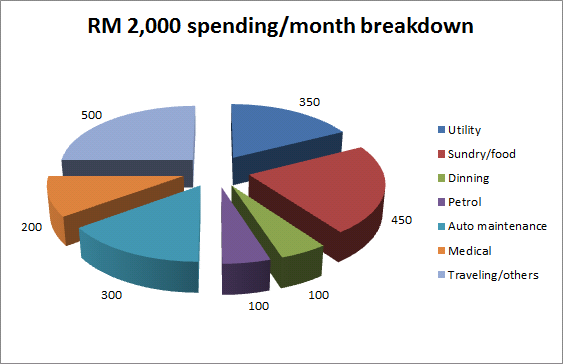
For a person who is debt free(no more housing and auto loans), I think RM 1,500 to RM 2,000 will be more than enough for me. This chart is just I would budget my RM 2,000. Please note, I budgeted average almost RM 500/month(RM 6,000/year) for traveling if no surprises coming up to compete for this fund. If something happen, sorry-lah - no traveling that year.


I think a person who occupied mostly with daily mundane routine, RM 24,000 a year will be enough.

Once we get over the "expense" stage, solving the rest of the equation will be easy. The next is deciding "return on investment".

Risk free = 3.5% in fixed deposit
Low risk = 5.5% bond
Medium risk = 7% REIT or dividend stock
High volatility(NOT high risk) = Equity 10%

If a person is very risk adverse, allocate 100% of their "capital" in FD, the required capital will be

RM 24,000 / 3.5% = RM 685, 714

If a person has stronger stomach = 30% FD, 20% bond, 30% REIT or high dividend stocks and 20% equity, the expected return on investment from this combo will be 6.25%. The required capital will be

RM 24,000/6.25 = RM 384,000

The range that we are looking at is somewhere RM 380,000 ~ RM 685,000.

To hit RM 685,000 by the age of 45, at 10% expected rate of return, this workout to be around RM 892/month. Not too far from this portfolio saving of RM 888/month. To save up RM 892/month by assuming saving 20% from his/her salary, a person would need a job of RM 4,500/month roughly. This will leave a person roughly RM 3,105/month to cope with the rest of expenses.

It's very tough but not impossible to be retired by the age of 45 but there will be lots of sacrifices during younger age and work like hell to make at least average of RM 4,500/month for 20 years. Please note that I excluded EPF savings as a margin of safety to fund children education. With average of RM 900/month savings from EPF, at 5% CAGR return, this will leave a person roughly RM 372 k after 20 years. Arithmetically, a person can be a millionaire(685 k + 372 k) by the age of 45. This a very frugal way that I know that can be done. The million ringgit question is do salaried men/women have this kind of will power and stamina to see their goal become reality?

Thursday, January 2, 2014

Parkson. Time for bottom fishing?

A reader asked me whether is it time for Parkson bottom fishing? Parkson Retail Group(HK listed), Parkson(KLSE listed) and Parkson Retail Asia(Singapore listed) have been moving in the same direction - South. Share prices have been performing very badly especially in the last 9 months where its share prices fell between 35 to 50%. Both Parkson Retail Group and Parkson Retail Asia are finding some stabilization footing while Parkson Holdings Berhad is still struggling to find a bottom.


I ran another chart comparing Parkson Retail Group(PRG) to its peers like Golden Eagle Retail and Intime Department Store. The general direction is about the same except the degree of under performing  are different. Overall sentiment towards retail sector has been negative especially with recent corruption clamp down by Xi's government. But then PRG is the worst lot of the three. So fundamentally, there must be differences among them and I suspect PRG is the worst.


Financial Performance of PRG is getting from bad to worse to worst. Operating revenue though exhibit some pressures but the costs are really moving in the wrong direction. Rental cost is escalating. Staff cost is escalating. Over a period of 2 years, the two costs had increased by almost 57%. As a result, margin from operations declined from mid 30s to single digit. Part of the costs increased to be fair are related to losses from six new stores opening and also related to temporary closure of Shanghai flagship for renovation. Even we normalize this, I believe Parkson margin at best may go back to 20s but it is still a lot of works to be done.


To be honest, when I see an analyst issuing a SELL rating, I usually would sit up and take notice -- grill the report and see whether they are wrong and profiting by taking a contrarian  position. When I saw this report a few months ago that the analyst made a sell call when the price was at HKD 3.52 with a target of HKD 2.20, I was impressed with her courage to make such a big call like that. By the way, her target price was really reached that level just recently. The target price was based on 7~8 times PE, cheap but can be dead money for a while to wait for fundamental to catch up.

Now you must be wondering why am I talking so much about PRG and yet to touch on Parkson Holding Berhad(PHB). It's because almost 80% of its profit derives from PRG. The contributions from Indonesia, Vietnam and Myanmar are still small and need to go through a long period of gestation. Malaysia operations is quite decent but kind of stagnant for the last 7 quarters with exception in Q2 of 2013(bungee jump). Let's pray hard Malaysians will still shop a little despite of higher cost of living pressures and hope Visit Malaysia this year can turn things around a bit.


Coming back to PHB. From a technical standpoint, the share price is really in a very oversold territory and a powerful relief rally can happen with RM 3.2 as a first target. If we are lucky, it can continue to climb to RM 3.40 or RM 3.80. Beyond that, I don't have any visibility.


The risk however is lack of institutional buying support. You can see the share price drop accelerated in December when GIC(Government Investment of Singapore) and KWAP(Kumpulan Wang Persaraan) were disposing. Unlike the period from August to November, LTH(Lembaga Tabung Haji) was buying aggressively, hence supporting the share price.


As you can see both KWAP and GIC both hold more than  100 million shares combined, if they turn net sellers as you can see they have been doing so in the last few months - the stock price can be depressed at least 3 ~ 6 months. I hope they can stop selling so that the stock price can have some breathing space.


While the bad news seem to be endless, a lot of bad news had been baked in. I can see now value investors begin to find the stock attractive and beginning to take some positions. From PE stand point, it is cheap. It's selling for a single digit PE with long term direction of consumer spending is there. Having said that, unless one is realy willing to buy and forget(10-15 years horizon with 5% annual dividend yield) or bet more value investors to buy more or making a quick technical rebound trade(1 month horizon) -- I can't really answer whether it is time for bottom fishing. But my advice is don't start with a technical trader to a buy and forget investor when you don't have a stomach to cut loss.

Wednesday, January 1, 2014

Turtleinvestor Portfolio 2014 Strategy

For those of you who are new to my blog, just a background recap for you.

I created a game for myself when I first started this blog in Feb 2008 when KLCI was around 1417. I started with seed money of RM 3,000 and with monthly saving of RM 888. The game will run for 15 years or 180 months. The goal was to generate annual compounding return of 10%.

I have completed about 71 months or 39% of the journey.

Just some key statistics as at 31 December 2013

Cash RM 68,788

Capital RM 64,356

Book value RM 72,616

Profit RM 8,119

CAGR:

Period = 22 months(Dec 2009) 5.22%
Period = 35 months(Dec 2010) 10.28%
Period = 47 months(Dec 2011) 3.67%
Period = 59 months(Dec 2012) 2.51%
Period = 71 months(Dec 2013) 3.00%

You must be thinking why was I not able to generate spectacular returns at the depth of 2009? One of the reasons available cash was too little, starting with RM 3,000 and monthly savings of 888, the cash available for deployment was only about RM 12k. As time went on, the accumulated savings grew but unfortunately Turtleinvestor portfolio stayed out of the market for almost 2 years. The other reason was I overweight China which happened to be one of the worst performers. But this is certainly not game over for me yet.

Based on the goals that I set above, I should have about RM 90,929. Unfortunately, I only managed to achieve RM 72,616 or fall short of RM 18,313. To catch up, based on the cash on hand of RM 68,788 I would need make a return of about 26%(18,313/68,788*100%). In my humble opinion, it is not difficult to catch up provided I don't make any unforced errors now. Cash of RM 68,788 is not that difficult to deploy. Just deploy about RM 17,197 for 4 investment ideas during market corrections or bear market would do the job.


The rule # 1 in investing is "Don't lose money". I have been very cautious, perhaps too cautious especially for public portfolio like Turtleinvestor portfolio, that cost me CAGR of 3% only. I am however quite satisfied because I did not lose money since the beginning.

The other rule is to be patience. Investing is a life long journey. Investing is really about getting a LIFETIME ACHIEVEMENT AWARD. I am sure everyone can agree to this. The moment you start earning says at 24 years old till you go back to haven is a long time. Assuming you go back to see the Lord at 74 years old, that will be 50 years. Any dumb mistake a person make can be devastating. If someone is fully invested at the peak of the market and losses 50%, RM 100,000 will go down to RM 50,000. To just get back to even of RM 100,000, a person will need to make 100% return on RM 50,000. At 10% CAGR, it will take a person 8 years to do that. Can you avoid losing self control not even a moment, over a period of 50 years?

To be honest, my ego was really bruised and tempted many times to make a few quick trades to make up 26% for Turtleinvestor portfolio. So what if I achieve that? I realize if I did that, I would have lost. Why? I would  have lost all the opportunities to let my readers to see my recovery process and how a real life investing is.

Don't get me wrong that I am preaching process is more important that results. It is NOT OK if you get the process right and NOT achieving the results. A successful investor is about getting the right investing process AND achieving results. My ultimate goal is to live the successful investing principles AND achieving the 10% CAGR goal.

So what is the strategy for 2014?

WAIT.

I realize that despite of my extremely low writing activities, many of you still coming back very regularly to check on my blog. I am very grateful for that. I hope to be able to share and write a little bit more in 2014.

Happy New Year!